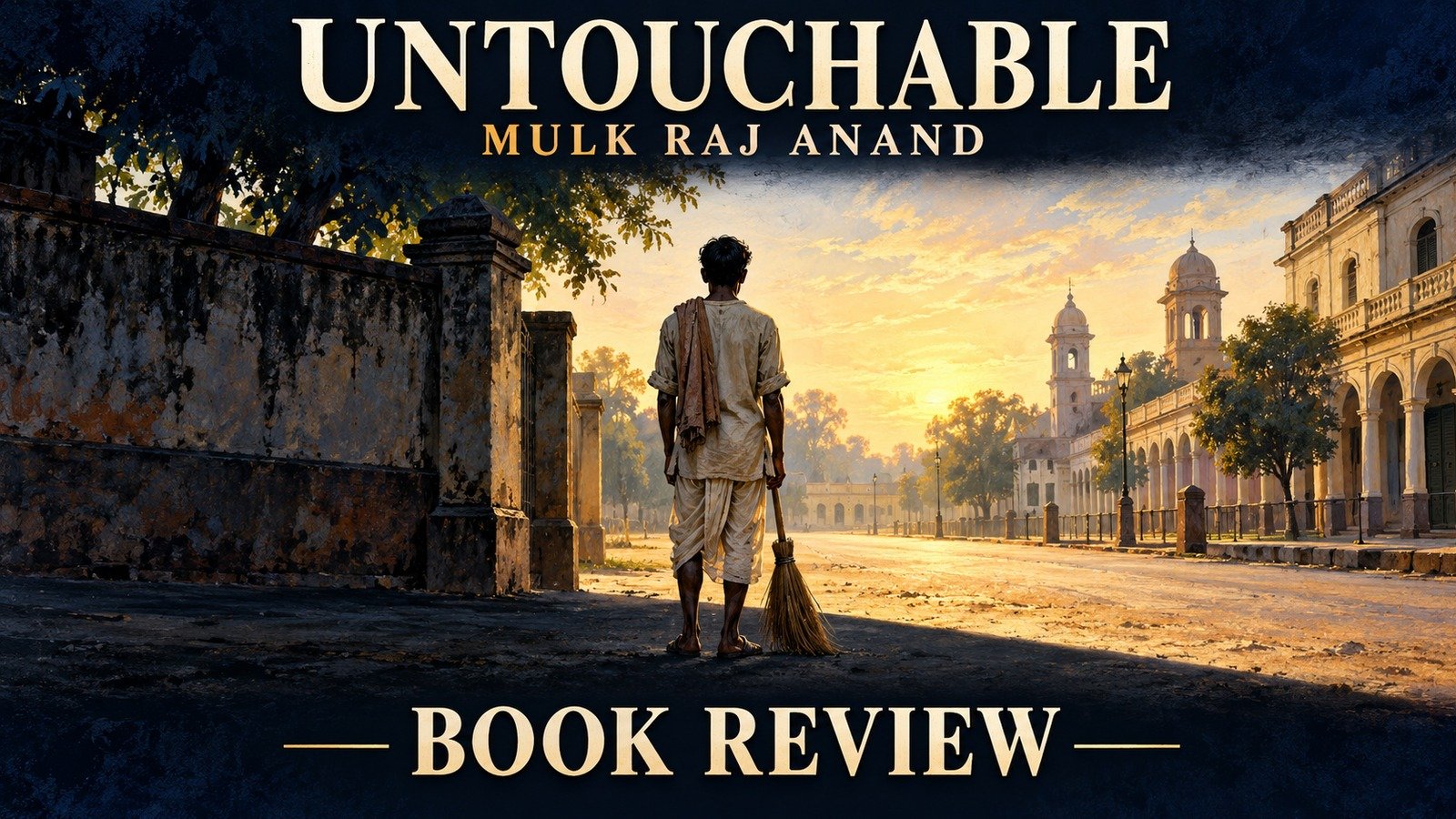
Mulk Raj Anand’s Untouchable does not ask readers to pity its hero from a safe distance. It asks us to walk beside him for one day, to feel how a society turns ordinary movements—working, eating, crossing a street—into tests of survival and dignity.
First published in 1935, Anand’s debut novel is brief, urgent and deliberately concentrated. Its central figure, Bakha, is a young sanitation worker living in a caste-segregated settlement in colonial India. He is strong, observant and proud of his appearance, yet the social order assigns him labour considered necessary while treating his presence as contamination. From that contradiction Anand builds one of the foundational novels of Indian writing in English.
One day, an entire system
The novel follows Bakha from morning through evening. He cleans latrines, navigates family tensions, moves through the town and tries to claim small pleasures for himself. An encounter in a crowded street exposes how little protection his youth, competence or good intentions provide. The remainder of the day gathers moments of insult, fear, anger, hunger and fragile hope.
This spoiler-light outline may sound simple, but simplicity is Anand’s method. By limiting the action to a single day, he prevents injustice from becoming an abstract historical subject. Caste enters through space, touch, water, food, work and speech. Bakha cannot step outside the system long enough to explain it calmly; he experiences it as a succession of rules whose cruelty is made to appear ordinary.
The bibliographic record matters here. The Library of Congress records the original Wishart publication in London in 1935 and describes Anand as a pioneer of Indian writing in English. The first edition carried a preface by E. M. Forster. A modern Penguin Classics edition includes an introduction by Ramachandra Guha and places Forster’s piece as an afterword, so readers should check the apparatus of the edition they choose.
Bakha is a person before he is a symbol
The novel’s greatest achievement is Bakha himself. Anand never makes him morally perfect in order to prove that he deserves humane treatment. Bakha can be impatient, vain, tender, resentful and confused. He admires the clothing and bearing of British soldiers without fully understanding the power structure around them. He wants cleanliness, freedom and recognition; he also wants sweets, a pleasant walk and a moment without supervision.
These ordinary desires protect the book from becoming a pamphlet. Bakha represents a vast injustice, but he is not reduced to representing it. Anand keeps returning to the body: fatigue after labour, the sensation of clothing, the shock of a blow, the awareness of hunger. The body that society labels “polluting” becomes the centre of perception. Readers see a town through the person it has trained itself not to see.
There is quiet irony in Bakha’s skill. The community depends on his work, and he performs it with energy, yet the same community uses that work to justify excluding him. Labour is demanded; the labourer is despised. Anand makes this hypocrisy visible without needing an elaborate plot.
Language at the edge of translation
Anand wrote in English while trying to retain the cadence, immediacy and social texture of Indian speech. The result can feel unusual to readers accustomed to polished British dialogue. Exclamations, repetitions and translated idioms give the prose a spoken force. At its best, the style lets English carry experiences that the colonial literary centre had largely ignored.
The narration moves close to Bakha’s thoughts and then widens into social observation. This movement creates urgency, although it is not always seamless. Some passages are intensely embodied; others explain their political meaning more directly. The tension between story and argument is part of the book’s history as a reformist novel—and part of what modern readers may admire or question.
Forster’s association with the novel helped it reach an international audience, but Anand’s accomplishment should not be treated as borrowed authority. The imaginative centre belongs to Bakha’s day, Anand’s moral anger and the particular Indian reality the novel insists English-language readers confront.
Colonial modernity is not an easy escape
Untouchable is sharply critical of caste hierarchy, but it does not present colonial influence as a clean rescue. Bakha’s attraction to British military style is understandable: it appears to offer order and an identity outside the humiliations he knows. Yet the colonial cantonment has its own divisions, and admiration can become another form of distance from oneself.
Late in the novel, Bakha encounters several proposed answers to the injustice surrounding him. They arise from moral reform, political speech and technological change. Anand gives each possibility genuine energy, but the sequence resists a neat solution. A human life cannot be repaired merely by hearing an idea, however powerful. Structural change must reach the body, the street, the well and the workplace.
This refusal of an easy emotional cure is one reason the novel still matters. It recognises that cruelty is sustained not only by openly hateful people but by habits, conveniences and institutions. Sympathy is necessary; it is not sufficient.
What the novel does powerfully
The one-day structure gives the book tremendous pressure. Each incident adds weight without requiring melodramatic escalation. Anand’s best scenes are concrete: a gesture, a queue, a piece of bread or a shouted word can reveal the architecture of the whole society.
The prose also makes moral attention inseparable from sensory attention. Dirt and cleanliness are not decorative contrasts. They expose who is forced to handle waste, who benefits from that work and who controls the meaning of purity. Anand turns sanitation into a political subject long before such labour commonly entered literary fiction.
Above all, the novel gives anger a human face. It does not flatter the reader for feeling compassion. Instead, it asks why compassion should be exceptional when Bakha’s personhood is obvious on every page.
Limitations and difficult reading
The supporting characters are often drawn more broadly than Bakha. Some function as embodiments of hypocrisy, exploitation or reform, and their dialogue can sound closer to debate than conversation. Readers who prefer ambiguity in every character may find the moral lines emphatic.
The final movement is intellectually crowded. Several large ideas arrive in quick succession, and the novel does not fully dramatise how any of them might transform Bakha’s future. This incompleteness may be intentional, but it can leave the ending feeling more provisional than resolved.
Modern readers should also expect casteist slurs, humiliation and an attempted sexual exploitation. Anand includes them to expose violence rather than to endorse it, but the reading experience is necessarily distressing. The book is short, not light.
Who should read Untouchable?
This is essential reading for anyone interested in Indian literature, caste, labour, colonial modernity or the development of the English novel beyond Britain. It suits readers who value compact social fiction with a close human focus. Those who prefer escapist plots or subtle satire may find its directness severe, but that severity serves the subject.
Readers who appreciated R. K. Narayan’s attention to performance and social expectation in our review of The Guide will encounter a very different tonal world here. Anand is less comic and more openly urgent, yet both writers ask how a community’s gaze can trap a person inside an identity.
Euonia Press verdict
Untouchable remains devastating because its moral argument begins with observation. Anand asks us to see Bakha’s strength, fatigue, vanity, fear and hope before any theory arrives to explain him. The novel’s didactic passages and compressed ending can feel uneven, but its central act of attention is extraordinarily clear.
More than ninety years after publication, the book still challenges the comfortable distance between recognising injustice and changing the arrangements that reproduce it. Bakha’s day is specific, but the question it leaves is wide: who performs the work a society needs, and what dignity does that society permit them to keep?
Featured illustration credit: AI-generated conceptual artwork created for Euonia Press.
Euonia Press Rating: 4.8/5 — A fierce, compassionate landmark whose concentrated form makes structural cruelty impossible to treat as an abstraction.