Euonia Press · Classic Book Reviews
A door closes, and someone is left outside. That small, recognisable hurt sits at the centre of Mary Shelley’s enormous imaginative achievement. In this Frankenstein review, we return to the novel behind the familiar monster image: a story about wanting recognition, refusing responsibility, and discovering how terribly those two desires can collide.
At Euonia Press, we believe a classic earns its place on a reader’s shelf through the questions it keeps alive. Shelley offers an especially uncomfortable one: when we bring something into the world, how much care do we owe it after the excitement of creation has passed?
Book: Frankenstein; or, The Modern Prometheus
Author: Mary Shelley
First published: 1818
Genre: Gothic fiction and early science fiction
Review approach: Spoiler-light; focuses on the 1818 text. Page counts vary by edition.
What is Frankenstein about?
Victor Frankenstein becomes consumed by the possibility of creating life. When he succeeds, his response is horror, and he abandons the being he has made. The creature must then learn how to exist in a world that recoils from his appearance. Their increasingly destructive relationship unfolds through accounts nested inside an explorer’s letters.
That structure asks us to listen carefully. Victor can explain his suffering at length, but eloquence does not automatically make him fair. The creature, too, wants to persuade his listener. Shelley makes the act of telling a story part of the moral problem: who gets heard, who controls the explanation, and whose pain is easiest to overlook?
The creature gives the novel its emotional force
The strongest reason to read this book is the creature’s developing awareness. He learns language, watches family life, and encounters books that help him imagine what human belonging might mean. Education gives him ways to understand his loneliness without supplying a place where that loneliness can end.
For a community built around reading, this is a striking idea. Books can expand our understanding while making us more conscious of what is missing from our lives. Shelley does not offer reading as an instant cure. Her creature can recognise tenderness and still be excluded from it.
Our sympathy is also tested. His anguish matters; the harm he causes matters as well. A weaker novel might invite us to choose one truth and ignore the other. Here, compassion has to coexist with judgement. That tension gives the story much of its staying power.
Victor’s ambition is easier to admire than his care
Victor is compelling because his imagination runs ahead of his willingness to accept consequences. He can picture discovery and distinction more readily than the daily obligations that would follow success. His great project has no adequate plan for the life it produces.
Our reading is that the novel’s sharpest warning concerns this failure of responsibility. Curiosity itself is not the whole offence. The deeper failure is treating achievement as a finish line when it has actually created a new relationship.
That gives Frankenstein a useful place in present-day conversations about invention and authorship. We do not need to claim that Shelley predicted a particular technology. The connection is an ethical one: creators should think about consequences, dependence, and care as seriously as they think about possibility.
Atmosphere that makes the arguments felt
The mountains, weather, distances, and ice do more than decorate the story. Their scale presses against the characters’ grand descriptions of themselves. A human voice can sound terribly certain until Shelley sets it beside a landscape that has no reason to share that certainty.
There is beauty here, and the beauty rarely removes the unease. The novel moves between intimate pleading and vast isolation. That movement makes its loneliness physical: we feel the distance between a warm human household and a life lived beyond its welcome.
Where the reading can feel demanding
The prose is formal, the emotional declarations are frequent, and some stretches move through recollection and argument rather than immediate action. Readers expecting a quick sequence of laboratory shocks may need to adjust their pace. We would choose a chapter or two at a time and allow the changes of narrator to settle.
The supporting women often receive less room to act than the men whose decisions shape the plot. Some of the cultural assumptions also deserve questioning. These limitations belong in the reading conversation; the book’s influence does not require us to admire every choice it makes.
If you are choosing an edition, check whether it prints the 1818 or the revised 1831 text. This review uses the earlier version. An introduction can help with context, although readers who want to protect the plot may prefer to read it afterwards.
Who should read Frankenstein?
We recommend it to readers who enjoy moral uncertainty, thoughtful Gothic fiction, and characters whose arguments are as important as their actions. It also suits a book club willing to disagree. Readers seeking a cheerful escape or fast horror adventure may find its grief and repeated self-examination heavy.
Reading note: The novel includes murder, bereavement, rejection, and intense distress.
A question for the Euonia community: At what point does understanding someone’s pain stop being enough to excuse their choices? Share your view in the comments, keeping later plot details behind a spoiler warning.
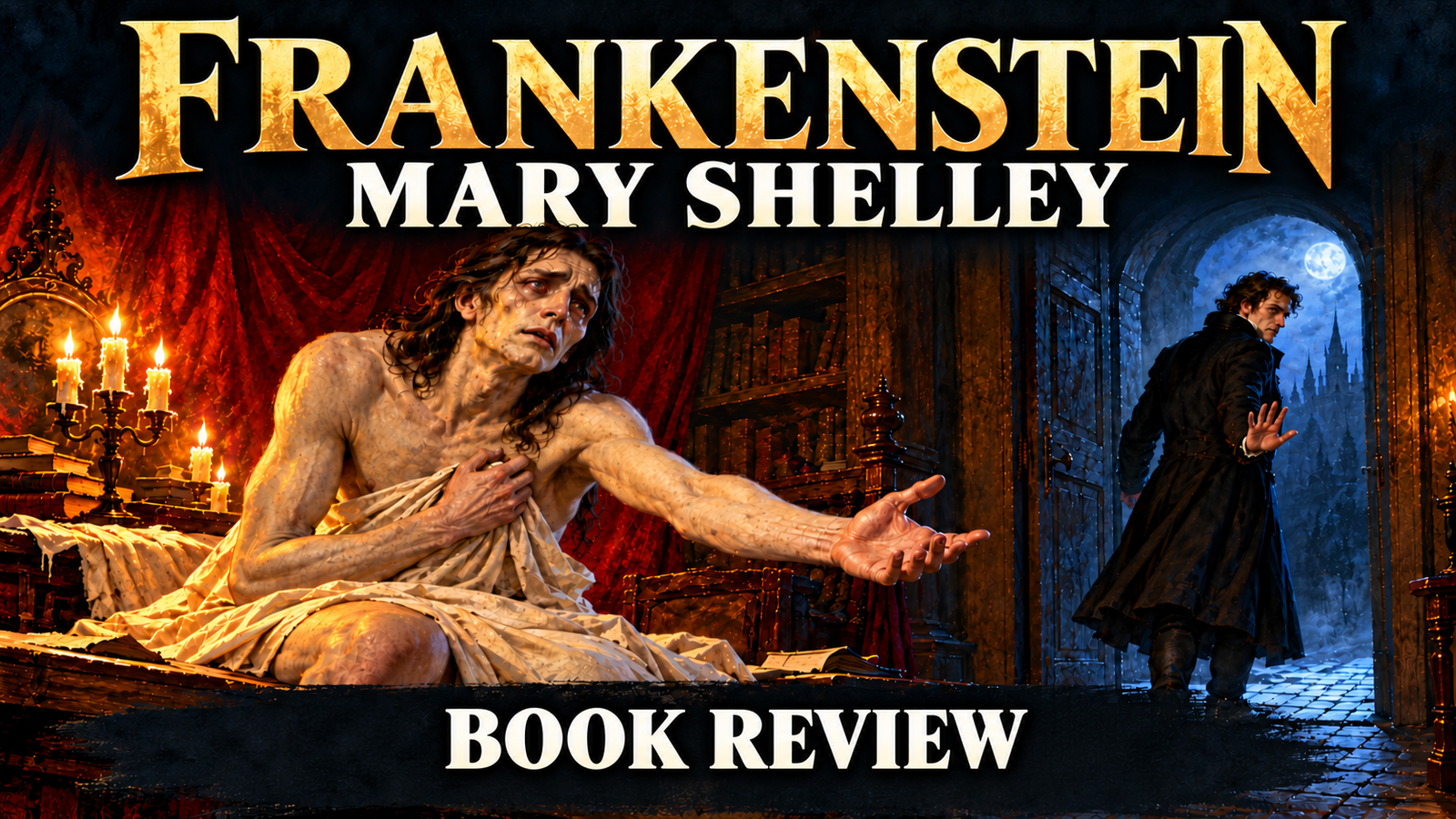
Text consulted: Project Gutenberg’s transcription of the 1818 edition. Interpretations and rating are Euonia Press’s editorial judgement. Featured artwork is an AI-generated conceptual illustration inspired by the novel.
Euonia Press verdict and final rating
Frankenstein earns our recommendation through the force of its central relationship and its refusal to make sympathy comfortable. Its formal pacing and uneven attention to supporting characters keep it from feeling equally strong on every page. Yet the question of what creators owe their creations remains powerful enough to carry the book far beyond its famous premise.
Euonia Press rating: 4.5 out of 5 — an exceptional, emotionally demanding classic.